Business Intelligence for Law Firms Turns Data into Answers

Most firms already have the data to answer their biggest operational questions in real time.
What’s missing isn’t information, it’s a way to see it.
A managing partner asks how the quarter is tracking. The answer can take three days: an email to the practice manager, an afternoon in the billing system, and a spreadsheet that gets downloaded or rebuilt from scratch because last month’s version doesn’t match this month’s format.
That firm already has what it needs to answer in real time. Billing history, work in progress (WIP), matter records, time entries. What’s missing isn’t information. It’s a way to see it clearly, quickly, and without someone losing an afternoon to pull it together.
This visibility problem is far more common than firms like to admit.
How firms end up here
Nobody builds a law firm around a reporting problem. It happens by accident, over years.
Most firms choose early on to run their business on a practice management system. Over time it collects years of data—billing history, WIP, matter records, time entries—all sitting inside it. However, reporting can often be treated as an afterthought by a firm, or something a paralegal can figure out in Excel.
When growth outpaces the reporting process meant to track it is when problems surface. A firm with five attorneys can run on spreadsheets and memory. A firm with 50 cannot operate efficiently on that level of manual labor. Systems rarely get rebuilt before the moment they stop working, they get patched instead: a new tab on the spreadsheet, a new field on the intake form.
The hidden cost of manual reporting in a law firm
Ask any managing partner or firm administrator how reporting works at their firm, and the answer usually involves one person buried in Excel. They’re often pulling data from a practice management system, a document management system, a tool there, and a tool over there, cleaning it all up in Excel, formatting it into something presentable, throwing it in a deck, and sending it around with a message – “does this look right?”
That person is spending hours on work that could be done in minutes. It creates a dependency on one person the whole firm quietly relies on, and when that person leaves, the institutional knowledge goes with them. Not to mention it risks decisions being made on stale or incomplete data.
Visibility is a business issue, not a technology one
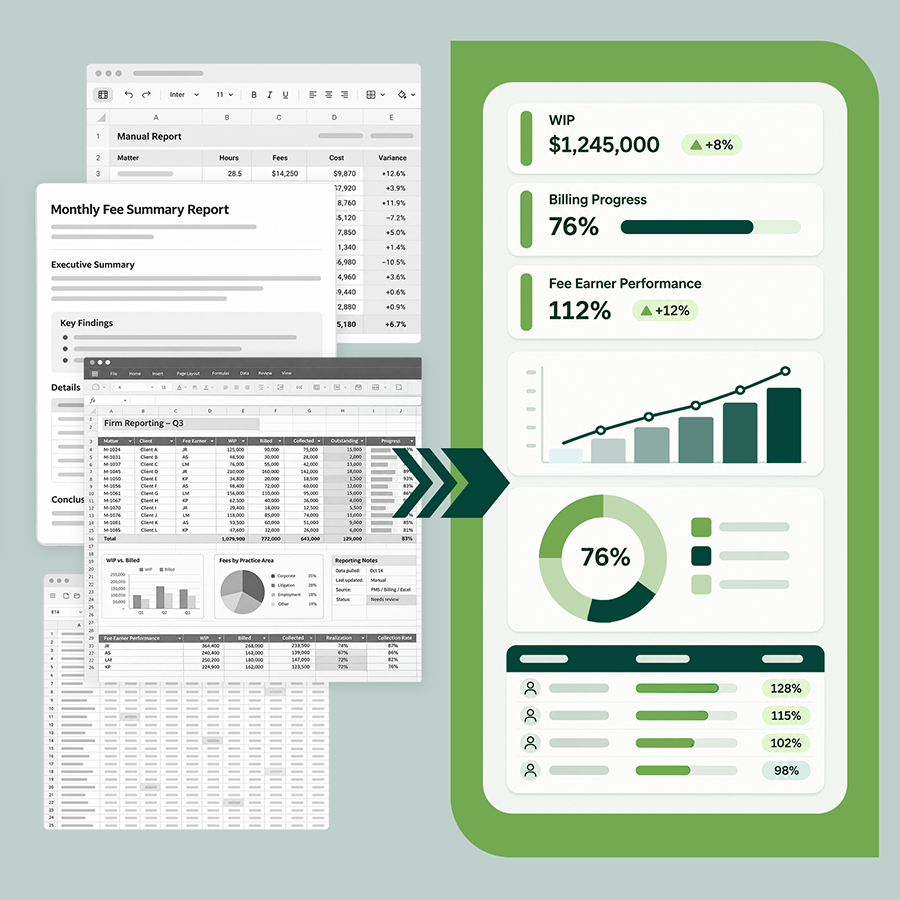
It is tempting to frame this as a software problem, that if firms just had better tools, the reporting would take care of itself. That is partly true, but it misses something important: visibility.
Visibility is a business issue. It shapes how confidently a managing partner can walk into a partnership meeting with a clear picture of business performance. It determines whether a firm administrator can catch a cash flow issue before it becomes urgent. It affects whether a practice group leader knows, in real time, whether their team is on track or quietly falling behind.
Firms that have current visibility into their performance operate differently. They ask better questions. They catch problems earlier. They do not spend the first two weeks of a quarter figuring out what happened in the last one.
Making the case for business intelligence
Business intelligence turns data a firm already has into answers a firm can actually use. Instead of a lawyer spending Friday afternoon pulling numbers out of a practice management system, the numbers are already there on one screen, and they’re current, accurate, and visible to the people who need them.
That shift sounds simple. For most midsize firms, it’s a meaningful change in reacting to staying informed.
What law firm business intelligence should look like
Good business intelligence for a law firm does a few specific things:
- It shows current numbers, not numbers from two weeks ago. A partner should see WIP, billing progress, and fee earner performance as they stand today, not as they stood at the last month-end close.
- It works without a request. A managing partner or firm administrator should be able to pull the reports they need without waiting for someone else to build it
- It sits on top of the systems the firm already runs on. Nobody wants to move their history from one tool to another just to get a dashboard. Finding business intelligence that lives in the same place data is captured and stored brings greater accuracy and efficiency.
- It shows the firm at every level. Depending on roles and settings, firm data can be shown to individuals at varying levels. A managing partner gets the whole picture. An individual lawyer sees their own performance.It surfaces problems early. Smart business insights make aging WIP and potential trouble areas visible before they become write offs.
Firms that get this right are buying the ability to stop guessing.
What changes when firms can see clearly
When a firm has real visibility into its own performance, the work of running it changes. Day-to-day operations shift. Slow paying clients and aging matters get flagged before they turn into write offs. Compensation conversations get shorter and less personal, because the data is doing the arguing instead of memory or politics.
There is a retention benefit too. The person who used to lose a day each month pulling reports gets that time back.
What this looks like with Actionstep
Firms running on Actionstep’s practice management platform already have this data: billing history, WIP, matter records, time entries. None of it needs to move anywhere new.
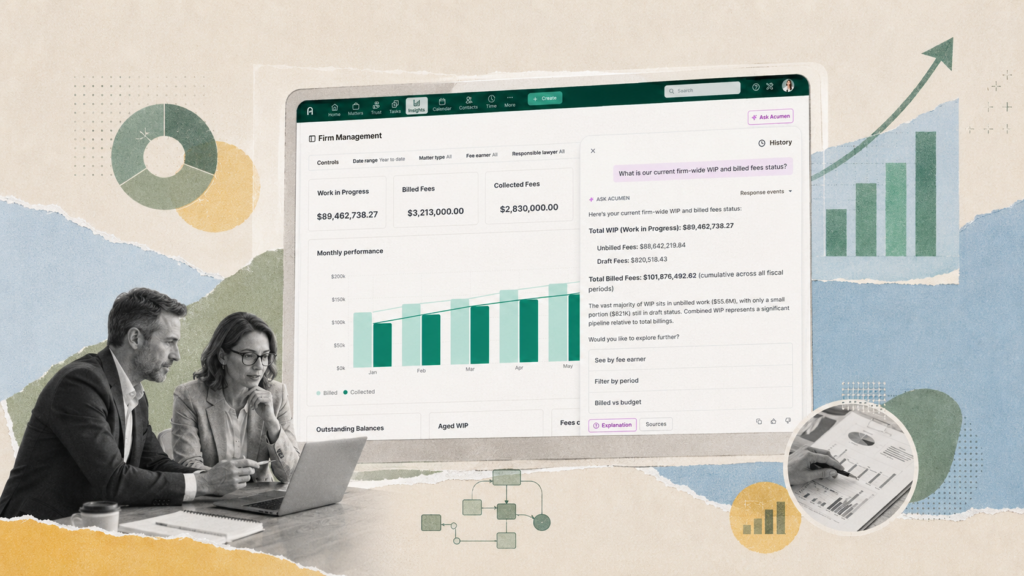
Actionstep’s business intelligence capability sits on top of what’s already there. Pre-built dashboards show WIP, billed and collected fees, aged balances, utilization, and realization, with drill-down from any summary number to the detail behind it. Metric definitions are standardized and data refreshes throughout the day, so everyone is working from the same numbers. Access follows role: firm leaders see the whole firm, and fee earners see their own performance.
Agentic Q&A lets users ask questions in plain language and get a focused answer as a single figure or table. It can also explain how any metric is calculated and what drove a change. Answers respect each user’s permissions, and nothing needs to be set up first.
Ready to go from approximating performance to measuring it?
See how Actionstep’s business intelligence capability brings pre-built dashboards and Agentic Q&A to the data your firm already has. Book a demo with our team to learn more.